To successfully learn how to build a routine with ADHD, start by anchoring small new habits to existing ones and prioritizing flexibility over rigid schedules. Utilize visual tools like timers or checklists to combat time blindness, and focus on one change at a time to prevent burnout. Maintaining a successful routine requires reducing mental load through external systems while practicing self compassion when disruptions occur.
For many adults living with ADHD, the word routine feels less like a solution and more like a broken promise. You likely start your week with a pristine, color coded schedule, only to find the system abandoned by Wednesday when life feels overwhelming. This cycle occurs because traditional productivity advice is built for neurotypical brains; however, your brain requires a framework that respects your need for novelty and visual stimulation. Creating a schedule that sticks is not a matter of willpower, it is about shifting your strategy to work with your unique executive functions. In this guide, we will break down why standard methods fail and introduce practical tools like the 3-3-3 rule and anchor tasks. You will discover how to use visual cues and printable planners to build a flexible, resilient routine that finally works for you.
Why Traditional Routine Advice Fails the ADHD Brain
Most productivity advice is built for neurotypical brains that function linearly. For those navigating the biological reality of ADHD, traditional systems often collapse because they ignore the fundamental mechanics of executive function. The ADHD brain operates on a unique temporal horizon often described as "Now versus Not Now." If a task does not have immediate urgency or novelty, it often slips into the "Not Now" void, making long-term planning feel like grasping at smoke.
This struggle is compounded by time blindness, which is the inability to intuitively sense the passage of time. When you cannot accurately gauge how long a task takes or how much time has passed, standard scheduling feels restrictive and unrealistic. The result is often task paralysis, a state where the sheer volume of steps required by complex organizational systems triggers sensory overwhelm. Instead of helping, these over-engineered methods become another source of friction that eventually leads to burnout.
The Simple Planners Hub philosophy is rooted in the belief that simplicity is the primary antidote to this cognitive clutter. We recognize that for an ADHD brain, a planner should not be a complex database of every life detail; it should be a grounding tool. By focusing on ADHD-specific planners that prioritize clean layouts and minimal distractions, we help bridge the gap between intention and action. Understanding how to build a routine with ADHD begins with accepting that your brain needs less noise, not more systems. By stripping away the non-essential, you reduce the executive load, allowing you to focus on what truly matters in the present moment.
The ADHD Golden Rules: 3-3-3, 1-3-5, and the 30 Percent Rule

Transitioning from the biological reality of executive dysfunction, we move into frameworks designed to work with, not against, your neurobiology. When you are learning how to build a routine with ADHD, success often depends on creating guardrails that prevent the common trap of over-planning. These three rules provide a practical structure for your daily list.
The 3-3-3 Rule is a foundational structure for managing a productive day. It suggests dedicating three hours to deep work on your most important project, completing three urgent tasks that require immediate attention, and checking off three maintenance tasks; these are the low-stakes chores like clearing your inbox or filing papers that prevent life from becoming cluttered. By categorizing tasks this way, you ensure that even on high-distraction days, the essentials remain visible.
For those who struggle with an endless to-do list, the 1-3-5 Rule offers a specific template for daily prioritization. You commit to exactly nine items: one big task that requires significant focus, three medium tasks, and five small, quick wins. This limit prevents the sensory overwhelm of a twenty-item list while providing the dopamine hits necessary to keep an ADHD brain engaged. Implementing these simple ADHD planner strategies helps transform a chaotic day into a series of manageable steps.
Finally, the 30 Percent Rule directly addresses time blindness. ADHD brains often underestimate how long a task will take, leading to time optimism that results in missed deadlines. To counter this, simply add 30 percent more time to every estimate you make. If you believe a report will take one hour, schedule eighty minutes. This buffer accounts for transitions and the inevitable distractions that arise. Using these rules alongside ADHD-specific planners aligns with the Simple Planners Hub philosophy of achieving transformation through simplicity, respecting your brain's unique rhythm and capacity.
Step One: Identify Your Anchor Tasks
Once you have internalized the 30 percent rule to protect your schedule, you must define the permanent architecture of your day. We call these "anchor tasks." These are the non-negotiables that happen regardless of your energy levels; examples include your first cup of coffee, your daily commute, or picking up your children from school. Because these events occur with high reliability, they serve as the perfect hooks for new behaviors through a technique known as habit stacking.
Instead of trying to summon a new habit out of thin air, you attach it to an existing anchor. For instance, you might decide that after you start the coffee maker, you will immediately open your ADHD-specific planners to review your 1-3-5 list. This creates a neurological bridge that bypasses the need for complex decision-making and helps you master how to build a routine with ADHD.
Task Type | Definition | Mental Impact |
|---|---|---|
Anchor Task | Fixed, daily non-negotiables. | Provides stability and a hook for new habits. |
Floating Task | Unscheduled tasks with no trigger. | Often lost in the Not Now void; causes anxiety. |
Visualizing your day with a simple ADHD daily routine checklist allows you to see exactly where these floating tasks can be grounded. Without anchors, tasks simply float in your mind until they are forgotten. By mapping your anchors, you build a resilient framework that remains visible even during periods of task paralysis. This approach embodies the Simple Planners Hub philosophy by replacing overwhelm with a clear, tactile structure that grounds the ADHD brain in the present moment.
The 5 Cs of Building ADHD Habits
While anchor tasks provide the physical structure for your day, the 5 Cs framework provides the emotional and neurological fuel to keep that structure standing. Understanding how to build a routine with ADHD requires more than just a list; it requires a strategy for motivation when interest fades. This framework, developed specifically for neurodivergent brains, focuses on Compassion, Connection, Consequences, Creative, and Competition.
Compassion is the most vital component. The ADHD routine disruption cycle often triggers a shame spiral; if you miss a morning of habit stacking, you might feel the entire system has failed. According to the Simple Planners Hub philosophy, a bad day is simply a part of the process, not a sign of failure. Practicing compassion allows you to reset without the heavy cognitive load of guilt, making it easier to return to your ADHD-specific planners the following day. By removing the pressure of perfection, you reduce the task paralysis that often follows a perceived mistake.
The remaining four Cs act as dopamine triggers to sustain engagement:
Connection: Using body doubling or sharing goals with a partner to create social accountability.
Consequences: Setting immediate, tangible stakes for completing tasks to combat time blindness.
Creative: Finding novel ways to approach mundane chores, such as using simple ADHD planner strategies like color-coding or stickers to make the process visually stimulating.
Competition: Gamifying your to-do list by racing against a timer or attempting to beat your personal best for focus duration.
By integrating these motivators, you shift from trying to force compliance to inviting engagement. This ensures your routine remains a helpful tool rather than a rigid burden.
Visual Cues and the Power of Printable Planners

While the 5 Cs provide the neurological fuel for your habits, the physical medium you choose dictates whether those habits remain visible throughout the day. In the debate between digital apps and paper tools, the ADHD brain often encounters a specific hurdle known as object permanence. For many, out of sight is out of mind is a literal daily reality. A digital planner tucked away in a smartphone app is frequently buried under a mountain of notifications, social media pings, and the screen glare that often triggers impulsivity.
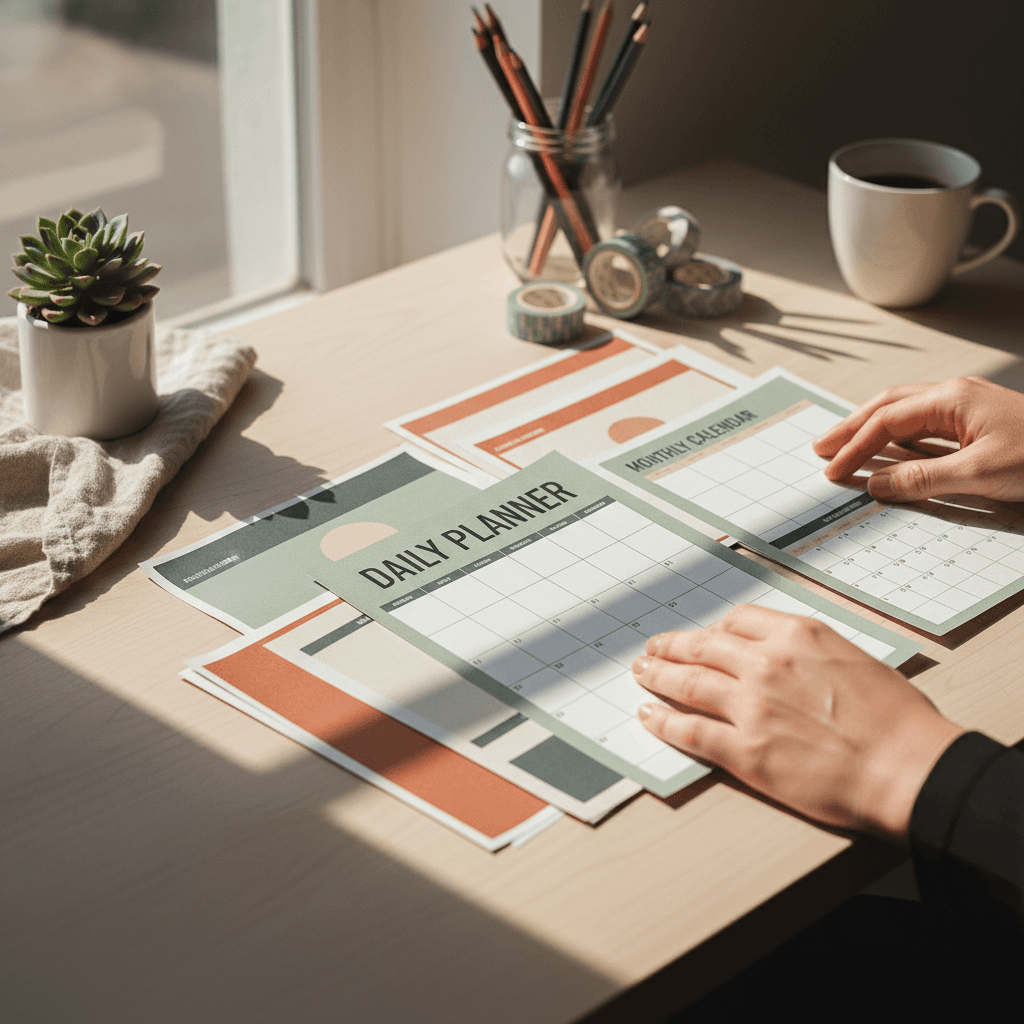
Using ADHD-specific planners in a printable format offers a distinct advantage. A physical sheet of paper sitting on your desk or pinned to your refrigerator serves as a constant, unignorable visual cue. It does not require you to unlock a device, which is often the exact moment where productivity is derailed by distractions. The tactile act of physically crossing off a task provides a sensory feedback loop that digital checkmarks simply cannot replicate.
Feature | Digital Apps | Printable Planners |
|---|---|---|
Visibility | Hidden behind screens or tabs. | Always visible in your physical space. |
Distraction Risk | High due to notifications and other apps. | Zero; focused entirely on the page. |
Cognitive Load | High; requires complex navigation. | Low; provides at-a-glance clarity. |
The Simple Planners Hub philosophy prioritizes minimalist designs because a cluttered page inevitably leads to a cluttered mind. When you are learning how to build a routine with ADHD, you need layouts that reduce cognitive load rather than adding to it. By implementing simple ADHD planner strategies such as utilizing clean white space and clear, bold headers, our printables ensure that your brain focuses on the task at hand rather than the tool itself. This focus on simplicity transforms your planner from a source of overwhelm into a reliable external brain.
Managing Routine Disruption and Boredom
The phenomenon of the two-week wall occurs when the initial novelty of a system wears off and the ADHD brain stops receiving the dopamine hits that fueled the start. This is not a personal failure; it is a signal that your brain needs a novelty injection. To maintain momentum in how to build a routine with ADHD, you must intentionally introduce minor variations that satisfy the need for stimulation without dismantling the underlying structure. Simple adjustments, such as switching from a standard pen to a vibrant gel ink or moving your workspace from a desk to a quiet cafe, can reset your interest levels.
When disruption inevitably occurs, the goal is rapid re-orientation. The ADHD brain often struggles to jump back into a sequence once a single link is broken, which frequently leads to an entire day of lost productivity. A pre-filled ADHD schedule template acts as a mental map for these moments. Instead of expending cognitive energy trying to remember where you left off, you refer to the template to identify the next anchor task and restart from there. This minimizes the executive effort required to get back on track.
The Simple Planners Hub philosophy emphasizes that a routine is a flexible tool rather than a rigid cage. By utilizing simple ADHD planner strategies like rotating your visual themes or using high-contrast stickers, you keep the interface of your planning system fresh. If you miss a day, avoid the temptation to redo the entire week or wait for next Monday to restart. Simply flip to a fresh page in your ADHD-specific planners and start with the next available anchor. Success in managing ADHD is found in the ability to pivot, not in the maintenance of perfect streaks.